
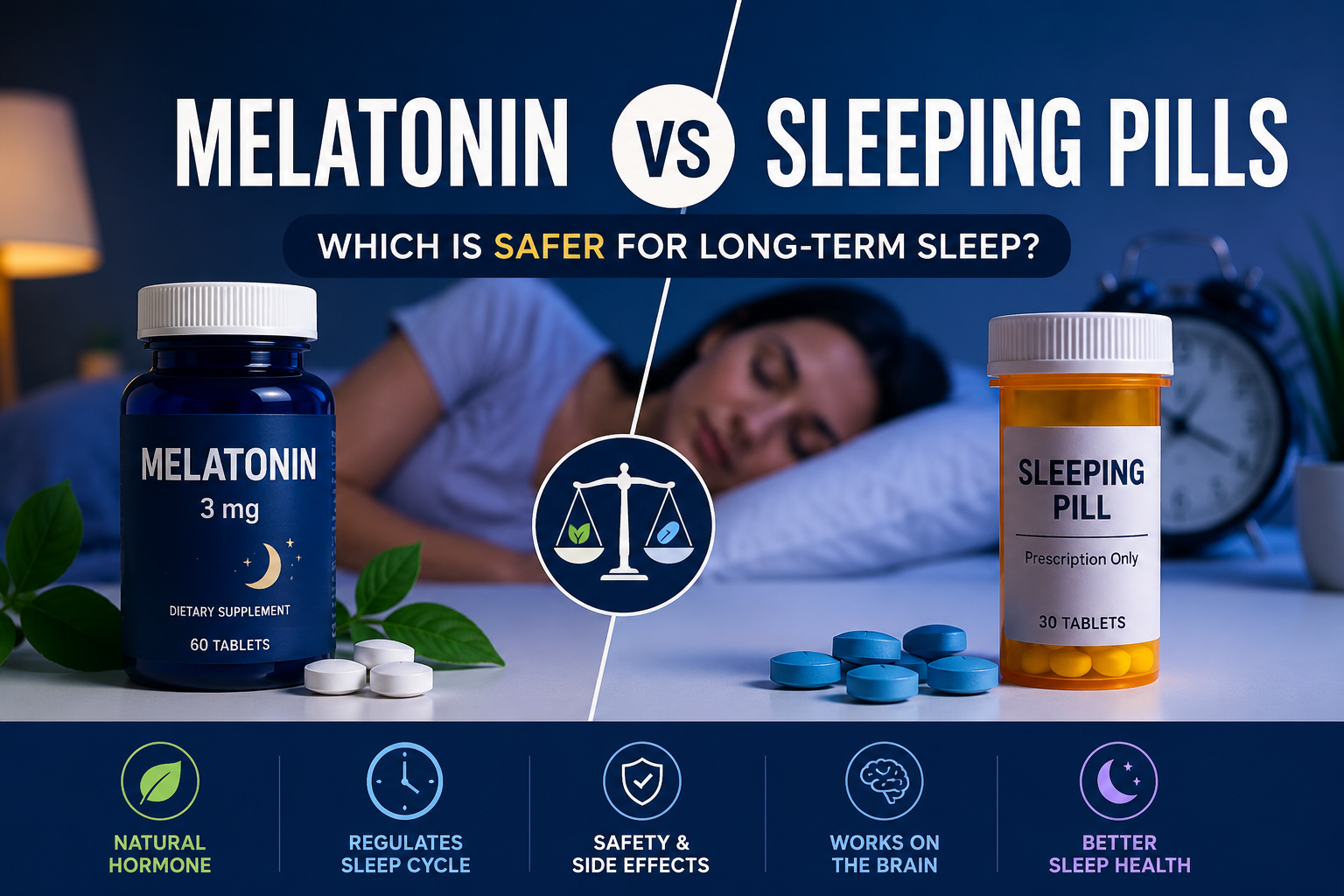
Melatonin vs Sleeping Pills: Which Is Safer for Long-Term Sleep?
Sleep problems can leave you wondering whether melatonin vs sleeping pills is the safer choice for long-term sleep. While both options may help with sleep, they work in very different ways and have different safety considerations. Understanding how melatonin and sleeping pills work can help you make a more informed decision about your sleep health.

So which one is safer for long-term use?
Let’s break it down clearly.
🌙 What is Melatonin?
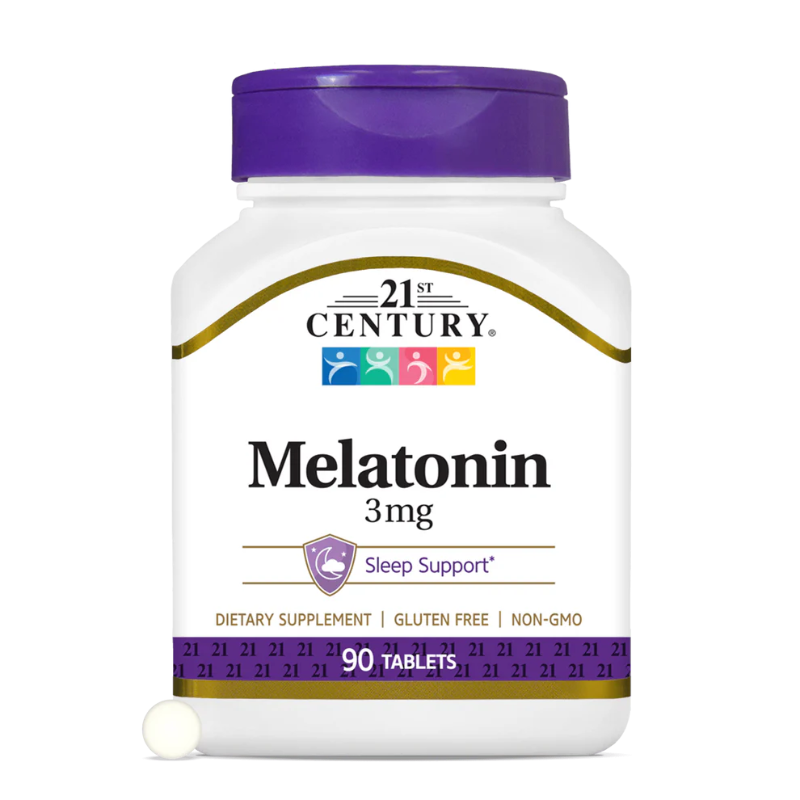
Melatonin is a natural hormone produced by the brain (pineal gland) that tells your body it is time to sleep.
🧠 It works like a biological “night signal.”
How melatonin supplements work:
- They do NOT sedate you
- They help regulate your sleep cycle (circadian rhythm)
- They are often used for:
- Jet lag
- Shift work sleep issues
- Mild insomnia
- Delayed sleep phase
👉 Think of melatonin as resetting your internal clock, not forcing sleep.
💊 What are Sleeping Pills?
Sleeping pills usually refer to prescription sedatives, such as:
- Benzodiazepines (e.g. diazepam, lorazepam)
- Z-drugs (e.g. zolpidem, zopiclone)
How they work:
- They act on the brain’s GABA receptors
- They depress brain activity
- They force drowsiness rather than regulate sleep
👉 Think of them as switching the brain into sleep mode, whether it is ready or not.
This melatonin vs sleeping pills comparison highlights the key differences in how they work, their potential risks, and their suitability for long-term sleep.
⚖️Melatonin Vs Sleeping Pills
| Feature | Melatonin | Sleeping Pills |
|---|---|---|
| Type | Hormone supplement | Prescription sedative |
| Action | Regulates sleep cycle | Induces sleep directly |
| Risk of dependence | Very low | Moderate to high (especially long-term) |
| Next-day drowsiness | Rare | Common |
| Long-term safety | Generally safer | Not ideal for long-term use |
| Use case | Mild sleep issues | Severe insomnia (short-term use) |
🧠 Safety for Long-Term Use
🌿 Melatonin: Generally safer
Melatonin is considered safer for long-term use because:
- It mimics a natural hormone
- It does not strongly suppress brain activity
- It has low risk of addiction
However:
- High doses may cause headaches or daytime sleepiness in some people
- Long-term use should still be guided if possible
⚠️ Sleeping Pills: Not ideal for long-term use
Sleeping pills may work quickly, but long-term use can lead to: https://www.nhs.uk/medicines/zolpidem/side-effects-of-zolpidem/
- Dependence (body relying on the drug to sleep)
- Tolerance (needing higher doses over time)
- Memory issues
- Next-day fatigue
- Rebound insomnia (worse sleep when stopped)
Doctors usually recommend them only for short-term insomnia management.
💡 When should each be used?
✔️ Melatonin is better for:
- Jet lag
- Changing sleep schedules
- Mild difficulty falling asleep
✔️ Sleeping pills are better for:
- Short-term severe insomnia
- Acute stress-related sleep disruption (under medical supervision)
When comparing melatonin vs sleeping pills, long-term safety is one of the most important factors to consider.
🧾 Final Verdict
If we compare overall safety:
👉 melatonin is generally safer for long-term use
👉 Sleeping pills are more effective short-term but riskier long-term
The best approach is not just choosing a supplement or drug — but restoring natural sleep rhythm and addressing underlying causes.
🌿 Vitalitygram Insight
Better sleep is rarely about “stronger medication.”
It is often about retraining the body’s sleep system naturally, then supporting it when needed.