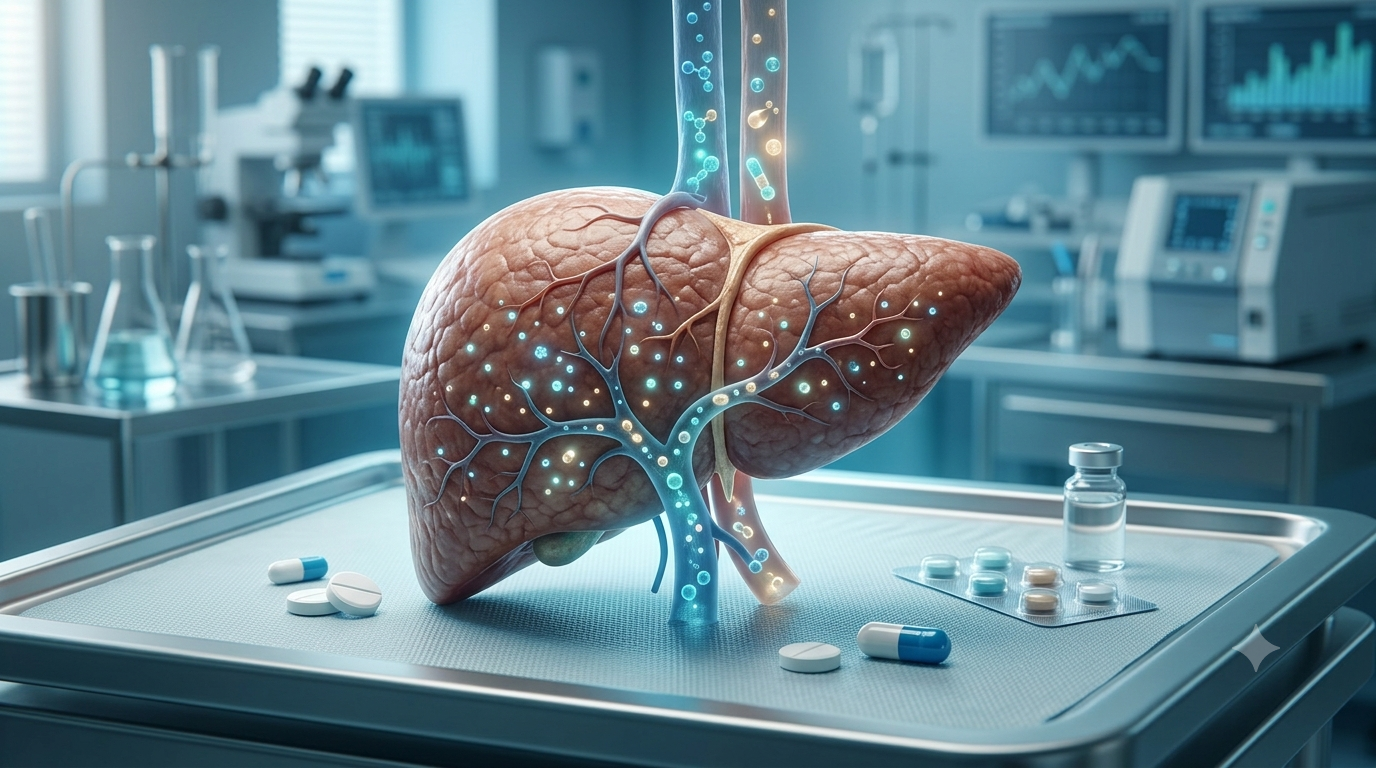
Your Liver Is a Chemical Factory: How Your Body Processes Medicines
Introduction
When you swallow a medicine, it doesn’t simply travel through your body and start working.
Before and after a medicine reaches its target, your body must absorb it, distribute it, transform it and eventually eliminate it. One of the most important organs involved in this process is the liver.
The liver acts like a sophisticated chemical processing centre. It contains enzymes that can modify many medicines, helping the body use, deactivate or eliminate them.
Understanding how the liver processes medicines helps explain why some medicines interact with each other, why certain foods or supplements can affect medications, and why liver disease can influence how some drugs should be used.
What happens after you take a medicine?
A medicine’s journey through the body is commonly described using the principles of pharmacokinetics.
A simple way to remember the process is:
Absorption → Distribution → Metabolism → Excretion
These four processes determine what happens to a drug after it enters the body.
1. Absorption
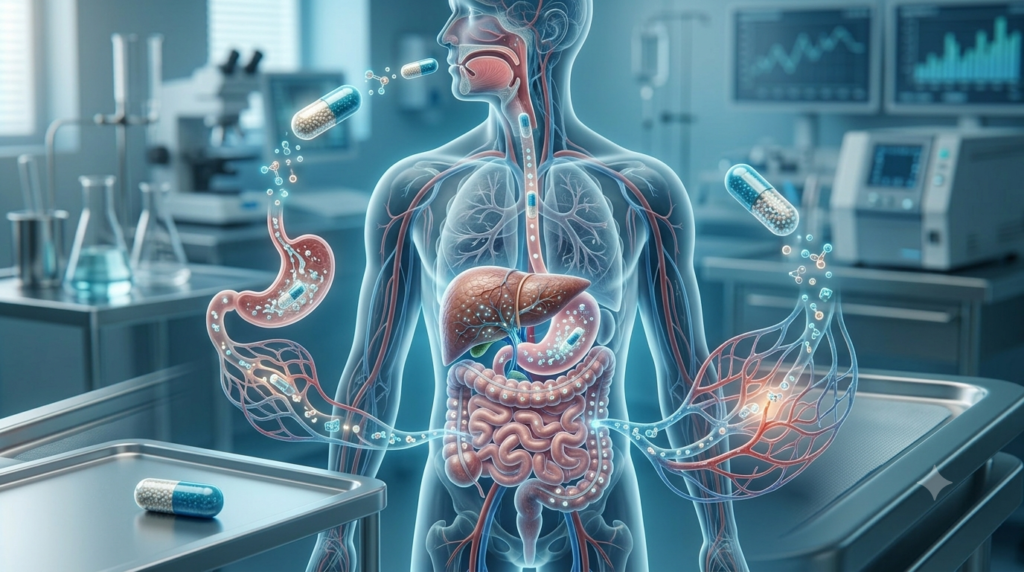
For an oral medicine, the drug first needs to be released from its dosage form and absorbed, usually through the gastrointestinal tract.
Once absorbed, the drug enters the bloodstream.
But oral medicines have an important checkpoint ahead.
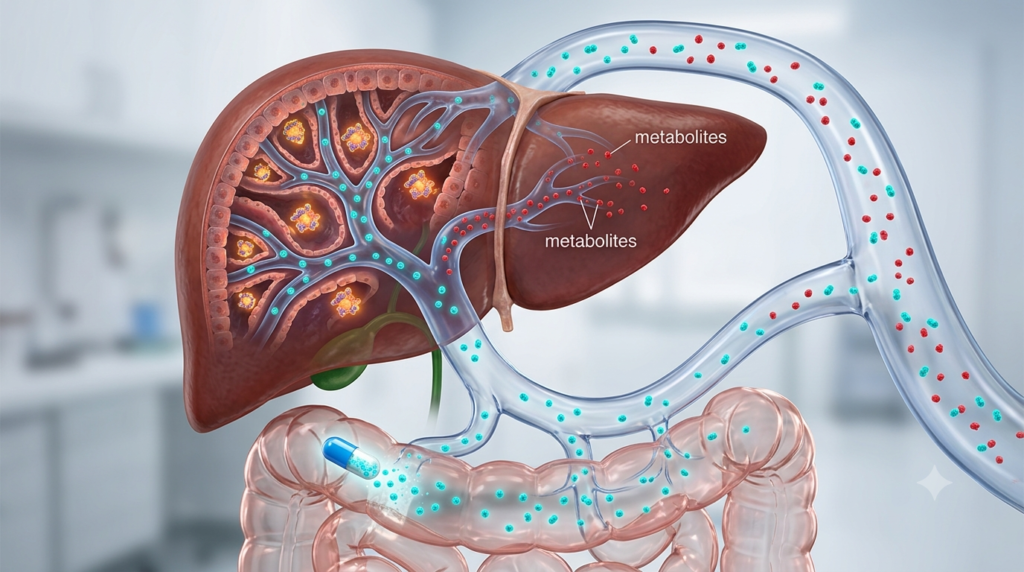
2. First-pass metabolism
Blood leaving much of the gastrointestinal tract travels to the liver through the portal circulation before reaching the systemic circulation.
As a result, some orally administered medicines can be metabolized in the liver before they reach the rest of the body.
This is known as first-pass metabolism.
The amount of drug that ultimately reaches systemic circulation is related to its bioavailability.
Some medicines are affected substantially by first-pass metabolism, while others are affected much less.
What does the liver actually do to medicines?
The liver contains numerous enzymes capable of chemically modifying drugs.
This process is called drug metabolism or biotransformation.
The purpose is often to make a drug or its metabolites easier for the body to eliminate, particularly by increasing their polarity and water solubility.
However, metabolism does not always mean that a medicine becomes inactive.
Depending on the drug, metabolism can produce:
- An inactive metabolite
- An active metabolite
- A metabolite with different pharmacological properties
- A toxic metabolite in some circumstances
This is why saying that the liver simply “destroys” medicines is an oversimplification.
It transforms them.
The CYP450 enzyme family
One of the most important groups of drug-metabolizing enzymes is the cytochrome P450 (CYP450) family.
Different CYP enzymes metabolize different medicines.
Some commonly discussed CYP enzymes include:
- CYP3A4
- CYP2D6
- CYP2C9
- CYP2C19
- CYP1A2
These enzymes are particularly important because their activity can vary between individuals and can be affected by other substances.
This helps explain why the same dose of a medicine may not produce exactly the same exposure in every person.
Why drug interactions happen
Drug interactions can occur when one substance changes the way another medicine is absorbed, distributed, metabolized or eliminated.
With metabolism, two important concepts are enzyme inhibition and enzyme induction.
Enzyme inhibition
An inhibitor reduces the activity of a drug-metabolizing enzyme.
If a medicine normally depends on that enzyme for breakdown, inhibition may cause the medicine to remain in the bloodstream for longer.
Its concentration may therefore increase, potentially increasing the risk of adverse effects for certain medicines.
Enzyme induction
An inducer increases the activity or expression of certain drug-metabolizing enzymes.
This can cause some medicines to be metabolized more rapidly.
As a result, their concentration may decrease and their therapeutic effect may be reduced.
The clinical significance depends on the specific medicines involved.
Why pharmacists ask about all your medicines

When a pharmacist asks what medicines, supplements or herbal products you are taking, there is a reason.
It isn’t enough to look at each medicine individually.
Healthcare professionals also need to consider what happens when medicines are used together.
For example, one substance may affect the metabolism of another and change its concentration in the body.
This is why patients should tell their healthcare professional about:
- Prescription medicines
- Over-the-counter medicines
- Vitamins and supplements
- Herbal products
- Recreational substances where clinically relevant
A product being sold as “natural” does not automatically mean it cannot interact with medicines.
Can food affect drug metabolism?
Yes.
Some foods and beverages can affect the enzymes or transport systems involved in drug disposition.
One well-known example is grapefruit, which can interfere with the metabolism of certain medicines, particularly those affected by intestinal CYP3A4.
However, the interaction depends on the specific medicine and the amount consumed.
This is why medication instructions sometimes include specific food-related warnings.
What happens when the liver is not functioning normally?
The liver performs many essential functions, including drug metabolism.
In people with significant liver impairment, the handling of certain medicines can change.
Depending on the medicine and the severity of liver dysfunction, drug exposure may increase or the formation of particular metabolites may change.
This can sometimes require changes in medication selection, dosing or monitoring.
Importantly, not every medicine requires the same adjustment.
The appropriate approach depends on the individual medicine, the patient’s liver function and other clinical factors.
What are prodrugs?
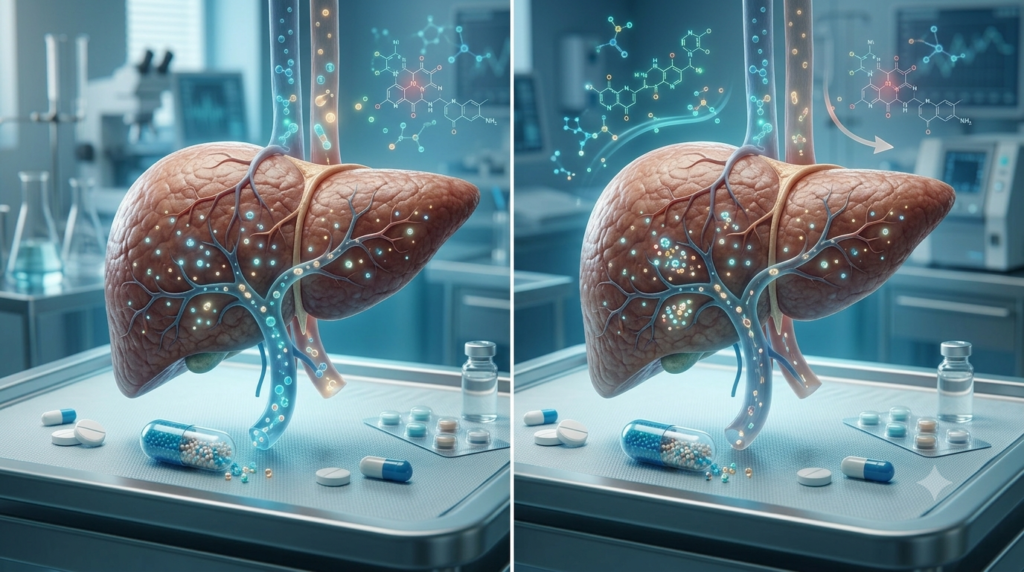
Here’s where pharmacology becomes particularly interesting.
Some medicines are administered in a form that is not fully active until the body converts them into an active metabolite.
These medicines are called prodrugs.
In other words, metabolism can sometimes be necessary for a medicine to produce its intended effect.
So the liver isn’t always reducing the effect of a medicine.
In some cases, its metabolic activity helps create the compound responsible for the therapeutic effect.
Why the same medicine can affect people differently
Two people can take the same medicine at the same dose and experience different levels of drug exposure.
Several factors can contribute to this, including:
- Age
- Liver function
- Kidney function
- Genetics
- Other medicines
- Food and supplements
- Smoking and other environmental factors
- Dose and dosage form
Genetic differences in some drug-metabolizing enzymes can also influence how quickly certain individuals metabolize particular medicines.
This is one reason pharmacology cannot always be reduced to a simple “one dose fits everyone” formula.
Pharmacokinetics vs pharmacodynamics
These two terms are easy to confuse.
Pharmacokinetics asks:
What does the body do to the drug?
It covers processes such as absorption, distribution, metabolism and excretion.
Pharmacodynamics asks:
What does the drug do to the body?
It focuses on the drug’s effects and mechanisms of action.
Together, they help healthcare professionals understand how a medicine behaves and produces its effects.
The big picture
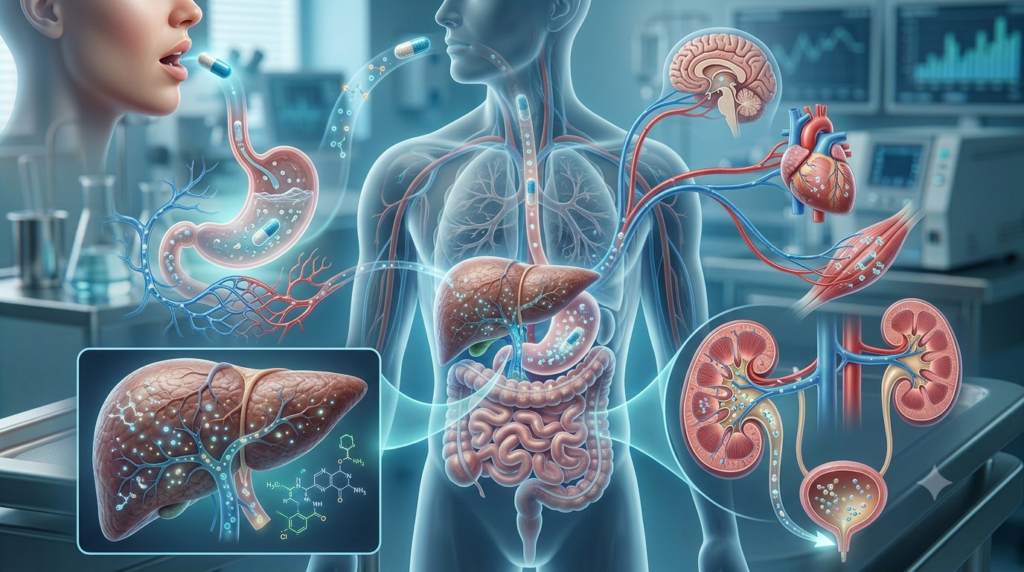
The next time you swallow a tablet, remember that the medicine is entering a remarkably complex biological system.
It must be absorbed.
It may pass through the liver.
It may be transformed by enzymes.
It may interact with other substances.
It eventually has to be eliminated.
Your liver is not simply a storage organ sitting quietly in the background.
It is an active chemical processing centre that plays a major role in how many medicines behave inside your body.
A final reminder
Never stop, start or change a prescribed medicine simply because you have read about a potential drug interaction online.
If you are taking several medicines, supplements or herbal products, speak with a pharmacist or other qualified healthcare professional about possible interactions.
Understanding your medicines is part of using them safely.
Vitalitygram — A healthy generation is all we seek to achieve.